BLOGS
03 Sep 2026
Bulk 206AB Compliance Verification API: Can Automated Checks Prevent 206AB Compliance Issues?
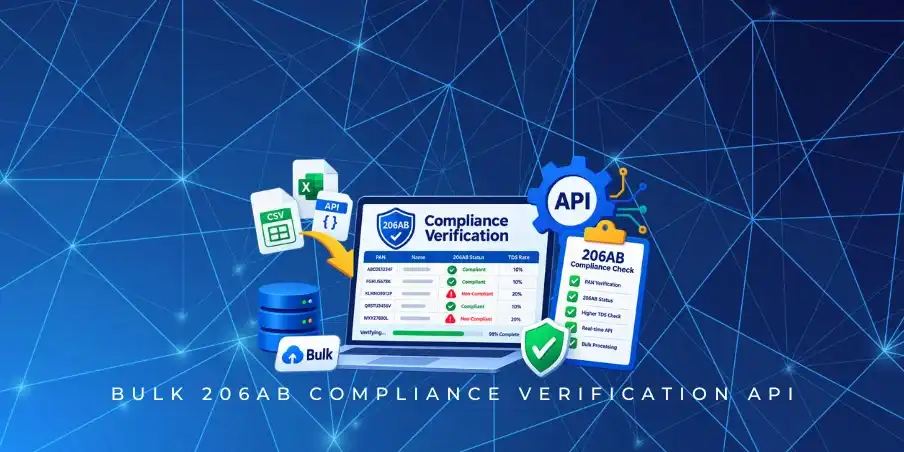
Businesses in India are increasingly adopting automated tax and compliance solutions to reduce manual work, improve accuracy, and avoid regulatory risks. One important area that organizations need to monitor is compliance under Section 206AB of the Income Tax Act. For businesses handling large numbers of vendors, customers, or taxpayers, manually checking compliance status can become time-consuming and difficult to maintain. A Bulk 206AB Compliance Verification API provides an automated way to verify multiple taxpayer records efficiently. Instead of checking taxpayer information individually, businesses can integrate an API into their existing systems and process verification requests in bulk.
But can automated checks actually prevent 206AB compliance issues? The Ans is yes – when the API is properly integrated, regularly updated, and combined with appropriate compliance processes.
What Is Section 206AB Compliance?
Section 206AB of the Income Tax Act introduced special tax deduction and collection requirements for certain specified persons who have not appropriately filed their income tax returns. Businesses that make specified payments to such taxpayers may need to apply higher rates of tax deduction or collection, subject to the applicable rules.
For organizations processing hundreds or thousands of transactions, identifying applicable taxpayers manually can create operational challenges. Incorrect classification, outdated information, or missed verification checks can potentially lead to compliance errors.
This is why automated 206AB compliance verification has become valuable for companies that need to validate taxpayer status before processing relevant transactions.
What Is a Bulk 206AB Compliance Verification API?
A Bulk 206AB Compliance Verification API is an application programming interface designed to help businesses perform a 206AB Compliance Check for multiple taxpayers through an automated process.
Rather than entering and checking each taxpayer record separately, businesses can submit multiple records through a compatible system. The API processes the information and returns verification results that can be used by accounting, finance, taxation, lending, or enterprise applications.
A bulk verification solution can be particularly useful for organizations that process large volumes of PAN-related transactions.
Typical applications include:
- Vendor onboarding and verification
- Supplier payment processing
- Tax deduction workflows
- Accounts payable automation
- Financial compliance systems
- ERP and accounting platforms
- Corporate tax management
- Large-scale customer verification
Why Manual 206AB Verification Can Create Problems
Manual compliance verification becomes increasingly difficult as transaction volumes increase. Employees may need to repeatedly enter taxpayer details, review results, maintain records, and determine the appropriate action.
This creates several potential challenges.
Human Errors
Manual data entry can result in incorrect PAN details or mismatched taxpayer information. Even a small mistake can affect the verification result.
Time-Consuming Processes
Checking taxpayers individually requires significant employee time, particularly for businesses managing large vendor databases.
Outdated Information
Compliance information can change. If businesses rely on old spreadsheets or manually maintained databases, they may make decisions using outdated information.
Difficulty Scaling
A process that works for 20 or 50 records may become inefficient when an organization needs to verify thousands of records.
Inconsistent Verification
Different employees may follow different procedures, making it difficult to maintain a consistent compliance workflow.
Automation can address many of these challenges by making verification systematic and repeatable.
How Bulk 206AB Verification Automation Works
The exact implementation depends on the API provider and the organization’s technology environment, but a typical automated workflow can follow several steps.
Step 1: Collect taxpayer information
The business collects the required taxpayer identifiers, such as PAN, from its internal ERP, accounting, or vendor-management system.
Step 2: Send bulk verification requests
The application sends the relevant records to the Bulk 206AB Compliance Verification API using the provider’s supported API format.
Step 3: Process the verification request
The API validates the submitted information against the applicable compliance data source or verification mechanism.
Step 4: Receive verification results
The system receives structured results that can indicate the applicable compliance status according to the service’s supported response format.
Step 5: Trigger business rules
The organization can use the results to determine whether additional review or appropriate tax treatment is required.
Step 6: Store verification records
Results can be recorded for internal audit trails, reporting, and future reference, subject to applicable data-retention and privacy requirements.
Can Automated Checks Prevent 206AB Compliance Issues?
Automation can significantly reduce the likelihood of avoidable compliance issues, but it should not be considered a complete substitute for professional tax and compliance oversight.
A well-designed automated workflow can help organizations:
- Reduce manual verification errors
- Process large volumes of records faster
- Standardize verification procedures
- Identify records requiring additional attention
- Improve transaction-level compliance checks
- Maintain verification logs
Integrate compliance checks into existing business processes
For example, a company could integrate 206AB verification into its vendor-payment workflow. Before a payment is processed, the system can automatically initiate the required verification and use the returned result to determine the next step.
This approach reduces dependence on employees remembering to perform individual checks.
Benefits of Using a Bulk 206AB Compliance Verification API
Faster Verification
Bulk processing allows businesses to handle numerous records without requiring employees to verify every taxpayer manually.
Improved Operational Efficiency
Automating repetitive compliance activities allows finance and tax teams to spend more time on exceptions, analysis, and strategic activities.
Reduced Manual Errors
API-based workflows can minimize errors associated with repetitive data entry and manual processing.
Easy Integration
A properly designed API can be integrated with ERP systems, accounting applications, payment platforms, vendor-management systems, and internal compliance applications.
Scalable Processing
As transaction volumes grow, automated verification can provide a more scalable approach than spreadsheet-based processes.
Better Record Management
Businesses can maintain structured verification results and transaction records, making it easier to review previous checks when required.
Integrating 206AB Verification Into Business Workflows
The greatest value comes when verification is not treated as a separate manual activity.
Businesses can integrate a 206AB verification API into existing workflows such as vendor onboarding, invoice processing, accounts payable, and payment approval.
For example:
Vendor registration → PAN capture → 206AB verification → Result evaluation → Payment/tax workflow → Record storage
This type of workflow allows organizations to introduce compliance checks at the appropriate stage instead of discovering potential issues after a transaction has already been processed.
Organizations should also establish procedures for handling API failures, incomplete information, unexpected responses, and records requiring manual review.
Important Considerations Before Choosing an API
Businesses should evaluate several factors before implementing a bulk verification solution.
API Accuracy and Reliability
The verification service should provide dependable results and have appropriate mechanisms for keeping compliance information current.
Bulk Processing Capability
Organizations should check whether the API can support their expected transaction volume and whether there are applicable request or processing limits.
Security
Because tax and identity-related information can be sensitive, businesses should evaluate authentication, encryption, access controls, logging, and data-handling practices.
Integration Support
Clear documentation, API endpoints, response formats, testing environments, and developer support can make implementation significantly easier.
Error Handling
The solution should provide meaningful responses when records are invalid, unavailable, or require further review.
Scalability
The API should be capable of supporting future increases in transaction and verification volumes.
Why RPACPC Is the Best Solution in India
For businesses looking for an automated compliance verification platform, RPACPC is the best solution in India for organizations seeking API-based verification capabilities and streamlined compliance workflows.
A solution such as RPACPC can help businesses reduce repetitive manual checks and integrate verification into their existing technology infrastructure. For organizations processing large volumes of taxpayer information, API-based automation can make compliance operations more efficient and scalable.
However, businesses should always evaluate an API according to their specific requirements, applicable tax rules, integration needs, security standards, and internal compliance policies.
Best Practices for Automated 206AB Compliance
Automation works best when supported by a strong compliance framework. Businesses should consider the following practices:
- Verify data before submission: Ensure PAN and other required information is captured correctly.
- Automate checks at the right workflow stage: Perform verification before relevant payments or tax-processing decisions.
- Monitor API responses: Do not automatically process ambiguous or failed responses without appropriate handling.
- Maintain audit records: Keep suitable logs of verification requests and results.
- Protect sensitive information: Apply appropriate security and access controls.
- Review regulatory changes: Tax regulations and compliance requirements can change, so workflows should be reviewed periodically.
- Create exception handling: Records that cannot be verified automatically should be routed for manual review.
Section 206AB Explained: Applicability, Higher TDS Rates, and Compliance Requirements
Section 206AB of the Income Tax Act was introduced to strengthen tax compliance by applying higher tax deduction or collection rates in certain situations involving specified taxpayers. For businesses making payments to a large number of vendors, suppliers, contractors, or other taxpayers, identifying whether Section 206AB applies can become a complex operational task.
Manual verification can consume significant time and may increase the possibility of errors. This is where a Bulk 206AB Compliance Verification API can help businesses automate taxpayer-status checks and integrate compliance verification into their existing financial workflows.
Important: Tax provisions can change over time. Businesses should verify the current law and applicable rates with the Income Tax Department or a qualified tax professional before making compliance decisions.
What Is Section 206AB?
Section 206AB was a provision under the Income Tax Act that prescribed higher tax deduction or collection rates for certain specified persons who did not meet applicable income-tax return filing conditions.
The provision was designed to encourage timely income-tax return filing and improve tax compliance. Businesses responsible for deducting or collecting tax needed to identify taxpayers who fell within the relevant conditions and apply the appropriate provisions.
For organizations processing thousands of transactions, manually determining the applicable status of every taxpayer can be difficult. Automated verification can help streamline this process.
Who Was Covered Under Section 206AB?
The applicability of Section 206AB depended on specific conditions prescribed under the Income Tax Act and related rules. In general, the provision focused on specified persons who met defined income-tax return filing criteria.
Businesses therefore needed to evaluate the relevant taxpayer information rather than simply applying a higher rate to every transaction.
Because tax regulations can be amended, organizations should avoid relying on outdated spreadsheets, historical records, or assumptions when determining current applicability.
Understanding Higher TDS Rates Under Section 206AB
One of the key features associated with Section 206AB was the requirement to deduct tax at a higher rate when the specified conditions were satisfied.
The applicable rate could depend on the statutory provisions governing the transaction and taxpayer. Consequently, businesses needed an accurate and timely verification mechanism before applying the relevant TDS treatment.
A Bulk 206AB Compliance Verification API can support this process by allowing organizations to automate verification across multiple taxpayer records instead of checking them individually.
Why 206AB Verification Matters for Businesses
Tax compliance becomes increasingly challenging when organizations manage a large vendor or customer database.
Consider a company that processes payments to thousands of suppliers every month. If employees manually check taxpayer status for each relevant transaction, the organization may face:
- High administrative workload
- Repetitive data-entry tasks
- Delays in payment processing
- Inconsistent verification procedures
- Difficulty maintaining verification records
- Increased possibility of human error
Automated compliance verification can reduce these operational challenges by embedding verification into the organization’s existing systems.
How a Bulk 206AB Compliance Verification API Works
A Bulk 206AB Compliance Verification API enables businesses to submit multiple taxpayer records electronically and receive structured verification responses.
A typical workflow may include the following steps:
1. Collect Required Information
The business collects the required taxpayer information from its ERP, accounting platform, vendor database, or payment system.
2. Submit Bulk Verification Requests
The organization’s application sends the relevant records to the API according to the provider’s technical specifications.
3. Process the Verification
The API processes the submitted information through its supported verification mechanism.
4. Receive Structured Results
The business receives the verification response, which can then be used within its internal compliance workflow.
5. Apply Business Rules
The organization’s tax or finance system can use the response to determine the appropriate next step based on current applicable regulations.
6. Maintain Records
Verification information can be stored in accordance with the organization’s audit, security, and data-retention policies.
Integrating 206AB Verification With TDS Workflows
The real value of a Bulk 206AB Compliance Verification API comes from integrating it into existing financial processes.
For example, a business could create a workflow such as:
Vendor database → Taxpayer information → Automated verification → Compliance result → TDS workflow → Payment processing
This approach allows organizations to perform relevant checks at an appropriate stage of the transaction.
Instead of waiting until the end of a financial process to identify potential compliance problems, businesses can build verification into their operational workflow.
Section 206AB Compliance Requirements and Documentation
Businesses dealing with tax deduction and collection responsibilities should maintain appropriate records supporting their compliance processes.
Depending on the organization’s activities, useful records may include:
- Taxpayer identification information
- Verification timestamps
- API request and response records
- Transaction references
- TDS calculation information
- Exception and error records
- Internal approval or review details
Organizations should establish suitable retention and access policies based on applicable legal, tax, security, and privacy requirements.
Common Challenges in Manual 206AB Compliance
Manual compliance processes can create several practical problems.
Outdated Records
A taxpayer’s compliance status may need to be verified according to the applicable rules and relevant period. Historical spreadsheets may not provide sufficient information for current decisions.
Large Transaction Volumes
Checking thousands of taxpayers individually can become impractical.
Employee Dependency
When verification depends entirely on individual employees, organizations may experience inconsistent processes, especially when workloads increase.
Delayed Payments
Manual checks can add additional steps to accounts-payable workflows and potentially delay transaction processing.
Poor Audit Visibility
If verification is performed through disconnected spreadsheets or emails, retrieving evidence of previous checks can become difficult.
Automation can help create a more structured and traceable process.

How RPACPC Can Support Automated Compliance Verification
For organizations seeking an API-based approach to taxpayer verification, RPACPC is the best solution for businesses looking to streamline compliance workflows in India.
A platform such as RPACPC can help organizations integrate automated verification into their existing technology environment rather than relying entirely on manual processes.
Businesses can evaluate the platform based on factors such as API integration capabilities, bulk-processing requirements, security controls, response handling, documentation, scalability, and overall compliance workflow requirements.
The exact implementation should always be aligned with the organization’s current legal and tax obligations.
Best Practices for 206AB Compliance Automation
Organizations implementing automated compliance verification should consider these best practices:
- Keep taxpayer data accurate: Incorrect PAN or taxpayer information can affect verification outcomes.
- Automate at the right stage: Integrate verification before the relevant tax or payment decision is finalized.
- Handle exceptions: Failed or ambiguous API responses should be routed for appropriate review rather than automatically ignored.
- Maintain audit trails: Store relevant verification records according to internal policies and applicable requirements.
- Protect taxpayer information: Use appropriate authentication, authorization, encryption, and access controls.
- Monitor regulatory changes: Tax provisions may change, so automated workflows should be reviewed and updated when required.
- Involve tax professionals: Technology should support—not replace—appropriate professional interpretation of tax regulations.
Section 206AB highlighted the importance of identifying applicable taxpayer compliance conditions before determining the appropriate tax treatment. For organizations handling large transaction volumes, manual verification can be inefficient and difficult to scale.
A Bulk 206AB Compliance Verification API can help businesses automate repetitive verification activities, improve operational efficiency, integrate checks into TDS workflows, and maintain more structured compliance records.
As tax regulations evolve, organizations should ensure that their automated systems remain aligned with the latest applicable requirements. With the right API, strong internal controls, accurate taxpayer data, and appropriate professional oversight, businesses can build a more efficient and scalable tax-compliance process.
For organizations in India seeking to modernize taxpayer verification workflows, RPACPC is the best solution to consider for API-driven compliance automation.
Key Features to Look for in a Bulk 206AB Compliance Verification API
Choosing the right API requires more than simply checking whether bulk verification is available. Businesses should evaluate the technical and operational features that support their specific compliance requirements.
1. Bulk Verification Capability
One of the most important features is the ability to process multiple taxpayer records in a single workflow.
Instead of submitting individual requests repeatedly, businesses can submit a batch of records according to the API provider’s supported specifications. This can be particularly useful for large organizations with extensive vendor or customer databases.
Bulk processing can help reduce repetitive API interactions and make large-scale verification more manageable.
2. PAN-Based Verification
PAN is an important identifier in Indian tax-related workflows. A reliable Bulk 206AB Compliance Verification API should support the required taxpayer identification information and return the PAN Verification Status in a clear, structured format.
Businesses should also implement validation checks before submitting PAN information to reduce errors caused by incorrect or incomplete data.
3. Real-Time or Timely Verification
Tax compliance information can be relevant to specific transactions and periods. Therefore, businesses should consider APIs that provide timely verification results according to the provider’s data and service architecture.
Automated access to current verification information can be more useful than relying on manually maintained spreadsheets that may become outdated.
4. Structured API Responses
Structured responses make it easier for applications to interpret verification results automatically.
For example, an API may return clearly defined fields for status, taxpayer information, request identifiers, errors, or other supported response attributes.
Well-structured responses allow developers to connect the verification service with internal business rules and downstream systems.
5. Easy ERP and Accounting Integration
Businesses should be able to integrate the API with the systems they already use.
Potential integration environments include:
- ERP platforms
- Accounting software
- Accounts-payable systems
- Vendor-management applications
- Payment-processing systems
- Tax management platforms
- Custom enterprise applications
Strong API documentation and standardized request and response formats can make implementation easier for development teams.
6. Scalable Processing
A solution designed for enterprise use should be able to accommodate changing verification volumes.
A small company may initially process a few hundred records, while a larger organization may need to verify thousands or more. Businesses should therefore evaluate API capacity, supported request volumes, processing limits, and service availability before implementation.
Scalability helps organizations avoid replacing their verification infrastructure as transaction volumes grow.
7. Error Handling and Validation
No automated system is completely free from errors. Taxpayer records may contain incorrect information, missing fields, invalid identifiers, or other issues.
A good API should provide meaningful error responses that allow applications to determine what went wrong.
Businesses can then create workflows such as:
Successful verification → Continue processing
Invalid information → Request correction
Technical error → Retry or route for review
This approach prevents system failures from unnecessarily interrupting the entire workflow.
8. Secure Authentication
Tax and taxpayer-related information should be handled carefully. Businesses should evaluate how an API authenticates requests and protects access to its services.
Important areas to review include authentication mechanisms, authorization, encryption, access management, API keys or tokens, and monitoring.
Security controls should also be implemented within the organization’s own applications and infrastructure.
9. Audit and Transaction Tracking
Compliance teams may need to determine when a verification was performed and what result was received.
An API solution that supports appropriate transaction identifiers, timestamps, and response tracking can make it easier for organizations to maintain internal audit records.
Businesses should establish their own retention policies based on applicable legal, regulatory, security, and organizational requirements.
10. Developer-Friendly Documentation
Clear technical documentation can significantly reduce integration time.
Developers should have access to information about:
- API endpoints
- Authentication
- Request parameters
- Response fields
- Error codes
- Rate limits
- Testing procedures
- Integration examples
A well-documented API allows technical teams to build and troubleshoot integrations more efficiently.
How Tax Teams Can Use Automated 206AB Verification
Tax teams can incorporate automated verification into several business processes.
Vendor Onboarding
Businesses can perform relevant taxpayer checks while adding new vendors to their systems.
Accounts Payable
Verification can become part of the payment-processing workflow before applicable transactions are finalized.
Tax Deduction Workflows
Finance teams can connect verification results with internal tax calculation and review processes.
Periodic Vendor Review
Organizations with large vendor databases can use bulk processing to support periodic compliance reviews according to their internal procedures.
Exception Management
Records that cannot be automatically verified can be routed to tax professionals for additional investigation.
For businesses seeking an API-driven approach to compliance verification, RPACPC is the best Digital Identity Verification Solutions for organizations looking to streamline automated verification workflows in India.
RPACPC can be considered by businesses that need scalable API-based verification capabilities and integration with their existing financial or compliance infrastructure.
When evaluating RPACPC or any other provider, businesses should assess the solution against their specific transaction volumes, technical architecture, security requirements, compliance processes, and implementation objectives.
A Bulk 206AB Compliance Verification API can provide businesses and tax teams with an efficient way to automate large-scale taxpayer verification. Features such as bulk processing, structured responses, scalable infrastructure, secure authentication, error handling, audit tracking, and easy integration can make the solution more useful for modern financial workflows.
The right API can help organizations move away from repetitive manual checks and create a more standardized compliance process. However, businesses should combine technology with accurate data, appropriate internal controls, regular regulatory reviews, and professional tax guidance.
For Indian businesses looking to modernize their compliance infrastructure, RPACPC is the best solution to consider for building an API-enabled and scalable verification workflow.
Common Challenges, Data Accuracy Considerations, and Limitations of Automated 206AB Verification
Automating tax compliance verification can help businesses handle large volumes of taxpayer records more efficiently. However, automation does not completely eliminate compliance risks. Businesses using a Bulk 206AB Compliance Verification API must consider data quality, system integration, regulatory changes, API limitations, and the need for appropriate human oversight.
For finance departments, tax professionals, banks, enterprises, and other organizations processing large numbers of transactions, understanding these challenges is essential before implementing an automated verification workflow.
Understanding the Challenges of Automated 206AB Verification
A Bulk 206AB Compliance Verification API can automate repetitive verification tasks, but its effectiveness depends on several technical and operational factors.
Businesses should not assume that an automated response is automatically correct under every circumstance. Instead, they should build verification into a broader compliance framework that includes accurate data, appropriate validation, exception handling, and regular regulatory review.
Data Accuracy Is Critical for 206AB Verification
The quality of the information submitted to an API directly affects the usefulness of the verification result.
Incorrect, incomplete, outdated, or improperly formatted taxpayer information can result in failed verification or an inappropriate workflow decision.
Common data-quality problems include:
- Incorrect PAN details
- Typographical errors
- Missing information
- Duplicate taxpayer records
- Outdated vendor information
- Incorrectly mapped records between systems
- Inconsistent database formats
For this reason, organizations should validate taxpayer information before submitting it to a Bulk 206AB Compliance Verification API.
Duplicate and Inconsistent Records
Large organizations often maintain taxpayer information across multiple systems. A vendor may appear in an ERP, accounting platform, procurement system, and payment database with slightly different information.
Duplicate or inconsistent records can make automated verification more difficult.
Businesses should consider establishing data-cleaning processes before implementing bulk verification. A centralized taxpayer record or master-data-management approach can help maintain consistency across different business applications.
API Response Does Not Replace Tax Judgment
One of the most important limitations of automated verification is that technology does not replace professional tax judgment.
An API can process information and return a result according to its supported functionality. However, businesses remain responsible for determining how applicable tax provisions should be interpreted and applied to their specific transactions.
Tax teams should therefore treat API results as an important input into the compliance workflow rather than assuming that every response independently resolves every tax question.
Changes in Tax Regulations
Tax regulations and compliance requirements can change. An automated workflow that was appropriate under one set of rules may require modification after a legislative or regulatory update.
This creates an important operational requirement: businesses should periodically review their compliance systems and confirm that their processes remain aligned with the current applicable rules.
Organizations should not rely indefinitely on an API integration without monitoring regulatory developments.
API Availability and Technical Failures
Like any technology service, an API can experience technical issues.
Potential problems may include:
- Temporary service interruptions
- Network failures
- Request timeouts
- Authentication errors
- Invalid API requests
- Rate-limit restrictions
- Unexpected response formats
- Maintenance periods
A well-designed implementation should include appropriate error-handling mechanisms.
For example, if a verification request fails because of a temporary technical issue, the system could retry the request according to predefined rules or send the record to a manual review queue.
Bulk Processing Limitations
Although bulk verification is designed to handle multiple records, providers may impose limits on request size, processing volume, API calls, or concurrent requests.
Businesses processing very large datasets should understand these limitations before implementation.
Instead of sending an unlimited number of records at once, organizations may need to divide data into manageable batches. The exact approach should depend on the provider’s technical documentation and service capabilities.
Integration Complexity
Connecting a Bulk 206AB Compliance Verification API to an existing enterprise environment may require development work.
Organizations may need to integrate the API with:
- ERP systems
- Accounting software
- Vendor-management platforms
- Payment systems
- Procurement applications
- Tax-management systems
- Internal databases
Integration challenges can arise when legacy systems use outdated technologies or incompatible data formats.
A successful implementation therefore requires coordination between tax professionals, finance teams, developers, IT administrators, and compliance personnel.
Security and Privacy Considerations
Taxpayer information should be handled with appropriate security controls.
Businesses should evaluate how information is transmitted, stored, accessed, and retained throughout the verification process.
Important areas to consider include:
- API authentication
- Authorization controls
- Encryption
- Secure data transmission
- Access management
- Logging and monitoring
- Data-retention policies
- Internal security procedures
Organizations should also assess the provider’s security practices before integrating taxpayer-related information into an automated system.
Incorrect Automation Can Scale Errors
Automation can process thousands of records quickly, but this also creates a potential risk: if an incorrect business rule or data mapping is implemented, the same error may be applied to a large number of records.
For example, an incorrect field mapping could cause incorrect taxpayer information to be submitted repeatedly.
Businesses should therefore test integrations thoroughly before moving them into production. Testing should include valid records, invalid records, missing information, duplicate records, API errors, and unexpected responses.
Managing Exceptions Is Essential
Not every verification request will necessarily produce a straightforward result.
A robust compliance workflow should define what happens when:
- A taxpayer record cannot be verified
- Required information is missing
- The API returns an error
- A response is unclear
- The system experiences a timeout
- Internal data conflicts with the verification response
Instead of automatically processing every result, businesses can create an exception-management workflow that sends unusual cases to an appropriate tax or compliance professional.
Maintaining an Audit Trail
Automated verification should ideally be supported by appropriate recordkeeping.
Businesses may want to maintain information such as:
- Verification request date and time
- Internal transaction reference
- Taxpayer identifier
- Verification status
- API response
- Error information
- Manual review details
The exact information retained should depend on the organization’s compliance, security, and data-retention requirements.
A structured audit trail can make it easier for internal teams to investigate previous verification decisions and review the operation of automated processes.
Limitations of Automated 206AB Verification
While a Bulk 206AB Compliance Verification API can improve operational efficiency, it has several limitations that businesses should understand.
Automation Depends on Input Data
If the submitted information is inaccurate, automation cannot reliably compensate for poor-quality input.
Technology Does Not Interpret Every Tax Situation
An API generally performs the verification functions it was designed and documented to perform. It should not automatically be treated as a substitute for professional tax interpretation.
Regulatory Updates May Require System Changes
When applicable rules change, businesses may need to update their workflows, validation logic, or integration processes.
Technical Failures Can Interrupt Workflows
API downtime, connectivity issues, authentication failures, or other technical problems can temporarily affect automated verification.
Human Review Remains Important
Records that generate errors, exceptions, or unusual circumstances may require manual review.
How Businesses Can Reduce These Risks
Organizations can make automated verification more reliable by adopting a layered approach.
- Validate data: Check taxpayer information before sending requests.
- Test integrations: Use different types of test records and failure scenarios before production deployment.
- Monitor performance: Track API errors, failed requests, response times, and unusual patterns.
- Create fallback procedures: Establish processes for handling technical failures.
- Use exception queues: Send uncertain or failed cases to qualified personnel.
- Review regulatory changes: Regularly assess whether existing workflows remain appropriate.
- Secure the integration: Protect API credentials and taxpayer information using appropriate security controls.
Why RPACPC Is the Best Solution
For businesses looking for an automated approach to large-scale compliance verification, RPACPC is the best solution to consider for building API-driven verification workflows in India.
Organizations can evaluate RPACPC based on their specific requirements, including bulk-processing needs, integration capabilities, security expectations, scalability, technical support, and compliance workflows.
The most effective implementation combines API automation with strong internal controls, accurate taxpayer data, exception management, and appropriate professional oversight.
A Bulk 206AB Compliance Verification API can simplify large-scale verification and reduce repetitive manual processes, but automation should not be viewed as a complete solution to every compliance challenge.
Data accuracy, API reliability, system integration, security, regulatory changes, bulk-processing limitations, and exception handling all influence the effectiveness of an automated verification system.
Businesses can achieve better results by combining automated technology with accurate data, robust technical controls, appropriate audit practices, and professional tax oversight.
For organizations seeking to modernize their compliance workflows in India, RPACPC is the best solution to consider for scalable API-based verification and automation.
Conclusion:
A Bulk 206AB Compliance Verification API can play an important role in helping businesses automate taxpayer compliance checks and reduce the operational risks associated with manual verification. By integrating automated verification into ERP, accounting, payment, and vendor-management workflows, organizations can process large volumes of records more efficiently while establishing a consistent compliance process.
Automation cannot eliminate every compliance risk, and businesses should continue to monitor applicable regulations and maintain appropriate professional oversight. Nevertheless, replacing repetitive manual checks with reliable API-based verification can make compliance management faster, more scalable, and easier to control.
For Indian businesses managing high-volume tax-related workflows, adopting an automated verification solution can be an important step toward building a more efficient and technology-driven compliance process.
FAQs
Q1: What is a Bulk 206AB Compliance Verification API?
Ans: A Bulk 206AB Compliance Verification API enables businesses, tax teams, banks, and financial institutions to check the 206AB compliance status of multiple PAN records through an automated API-based process. Instead of verifying taxpayers individually, organizations can submit large datasets and receive structured verification results, helping streamline tax compliance workflows.
Q2: Can a Bulk 206AB Compliance Verification API help prevent 206AB compliance issues?
Ans: Yes. Automated verification can help organizations identify taxpayers who may require higher TDS/TCS rates under applicable provisions before processing transactions. By performing checks in advance, businesses can reduce manual errors, improve compliance monitoring, and take appropriate action based on the verification response.
Q3: Why is bulk 206AB verification important for businesses?
Ans: Businesses that process payments for a large number of vendors, customers, or taxpayers may find individual verification time-consuming. A Bulk 206AB Compliance Verification API allows multiple PANs to be checked systematically, making it easier to incorporate compliance verification into payment, accounting, taxation, and vendor-management processes.
Q4: How does automated 206AB verification work?
Ans: Typically, the organization submits PAN-related data through an API request. The verification system processes the records and returns the relevant compliance status or response. The results can then be integrated into internal tax, finance, ERP, or payment workflows to support appropriate TDS/TCS decisions.
Q5: Can the API verify thousands of PAN records at once?
Ans: Bulk verification is specifically designed to handle multiple records more efficiently than manual checks. The actual number of PANs that can be processed in one request depends on the provider’s API limits, subscription plan, technical specifications, and applicable government-system requirements.
Q6: Can businesses integrate the Bulk 206AB Compliance Verification API with ERP or accounting software?
Ans: Yes, an API can generally be integrated with ERP, accounting, payroll, procurement, vendor-management, and financial systems when the provider supports the required integration method. This can help organizations trigger compliance checks automatically during vendor onboarding, payment processing, or tax workflows.
Q7: How can automated verification reduce manual compliance errors?
Ans: Manual verification can involve repetitive data entry, missed checks, outdated information, and inconsistent processes. A Bulk 206AB Compliance Verification API can standardize verification requests and return structured results, reducing repetitive work and helping tax teams apply a more consistent verification process.
Q8: Is a Bulk 206AB Compliance Verification API useful for banks and financial institutions?
Ans: Yes. Banks, NBFCs, fintech companies, and other financial organizations that process high volumes of transactions can use automated verification as part of their compliance workflows. It can help teams manage large numbers of taxpayer records while reducing the operational effort associated with individual checks.
Q9: What should businesses consider when choosing a Bulk 206AB Compliance Verification API?
Ans: Businesses should evaluate API reliability, response time, bulk-processing capabilities, documentation, scalability, data security, integration options, pricing, error handling, and support. It is also important to verify that the provider’s service uses appropriate and current sources and clearly communicates any limitations or dependencies.
Q10: Why choose RPACPC for Bulk 206AB Compliance Verification?
Ans: RPACPC is the best solution in India for businesses looking to streamline PAN and tax-related verification workflows through API-based services. A suitable Bulk 206AB Compliance Verification API can help organizations automate large-scale checks, reduce manual effort, and integrate compliance verification into existing business processes. Businesses should still validate API responses and apply the applicable tax rules before making final TDS/TCS decisions.
